Showing posts with label space. Show all posts

Friday, March 02, 2007

March 3rd Lunar Eclipse


Lucky skywatchers will witness a total lunar eclipse on Saturday evening, March 3rd. However, where you live will dictate whether you'll get to enjoy this grand celestial spectacle in prime time -- or watch the full Moon rise after it's all over. In the U.S. and Canada, the eclipse strongly favors those east of the Mississippi River, who'll see the Moon completely engulfed by Earth's shadow as night falls. Farther west, the Moon is only partly in shadow by the time it rises (at sunset).

Unfortunately, for anyone west of the Rockies, even the event's partial phase ends before moonrise. Only in New England, Quebec, and the Maritime Provinces does the sky become fully dark with the Moon still totally eclipsed. Farther east, the entire eclipse can be viewed from Europe, Africa, and western Asia, where it occurs late at night or before dawn on March 4th.

Below are key event times for the eclipse, given for five North American time zones; compare these with your times of local sunset and moonrise, which depend on your location (dashes: event not visible):

                             AST         EST         CST         MST       PST
Partial eclipse begins 5:30 p.m. -- -- -- --
Total eclipse begins 6:44 p.m. 5:44 p.m. -- -- --
Total eclipse ends 7:58 p.m. 6:58 p.m. 5:58 p.m. -- --
Partial eclipse ends 9:12 p.m. 8:12 p.m. 7:12 p.m. 6:12 p.m. --
Last shading visible? 9:50 p.m. 8:50 p.m. 7:50 p.m. 6:50 p.m. --
A total lunar eclipse occurs when the Sun, Earth, and Moon form a nearly straight line in space, so that the full Moon passes through Earth's shadow. Unlike a solar eclipse, which requires special equipment to observe safely, you can watch a lunar eclipse with your unaided eyes. Binoculars or a telescope will enhance the view dramatically. The outer part of Earth's shadow, called the penumbra, creates only a slight dusky shading on the lunar disk. But as the Moon begins to move into the central and darkest part of Earth's shadow, the umbra, there's an obvious and ever-larger "bite" in the full Moon. The partial eclipse is then under way.

The total eclipse begins when the Moon is fully within the umbra. On March 3rd, totality lasts 1 hour 14 minutes. But the Moon likely won't disappear completely. It usually glows as an eerie, coppery red disk in the sky, as sunlight scattered around the edge of our atmosphere paints the lunar surface with a warm glow. This is light from all the sunrises and sunsets that are
in progress around Earth at the time.

It's been 2.5 years since the last total lunar eclipse, on October 27, 2004. The next one, on August 28, 2007, will favor skywatchers in western North America over those in the east.

Monday, February 19, 2007

Eskimo Nebula


In 1787, astronomer William Herschel discovered the Eskimo Nebula, which from the ground resembles a person's head surrounded by a parka hood. In 2000, the Hubble Space Telescope imaged the nebula that displays gas clouds so complex they are not fully understood. The Eskimo Nebula is clearly a planetary nebula, and the gas seen above composed the outer layers of a sun-like star only 10,000 years ago. The inner filaments visible above are being ejected by strong wind of particles from the central star. The outer disk contains unusual light-year long orange filaments.

Image credit: NASA/Andrew Fruchter (STScI)

Wednesday, February 14, 2007

Satellite could see shadow of extra dimensions

A satellite to be launched next year could see signs of extra dimensions in the afterglow of the big bang, a new study says.

Some theories – such as string theory – that attempt to unify all known forces into a single "theory of everything" posit the existence of extra spatial dimensions beyond the three familiar ones.

But string theory has proven stubbornly resistant to experimental tests (although some physicists say it could be tested in the Large Hadron Collider scheduled to open by the end of 2007).

Now, Gary Shiu and Bret Underwood, both physicists at the University of Wisconsin in Madison, US, say the shape of the extra dimensions could leave an imprint in the afterglow of the big bang. This glow, called the cosmic microwave background, reveals the structure of the universe about 370,000 years after the big bang.

They use a popular model of the universe's early growth called Dirac-Born-Infeld (DBI) inflation, which is inspired by string theory. It is one of a class of ideas called braneworld models, which state that our universe is like a sheet of paper floating in a higher dimensional space.

full story @ newscientist.com

Sunday, February 04, 2007

Shadow of a Martian Robot


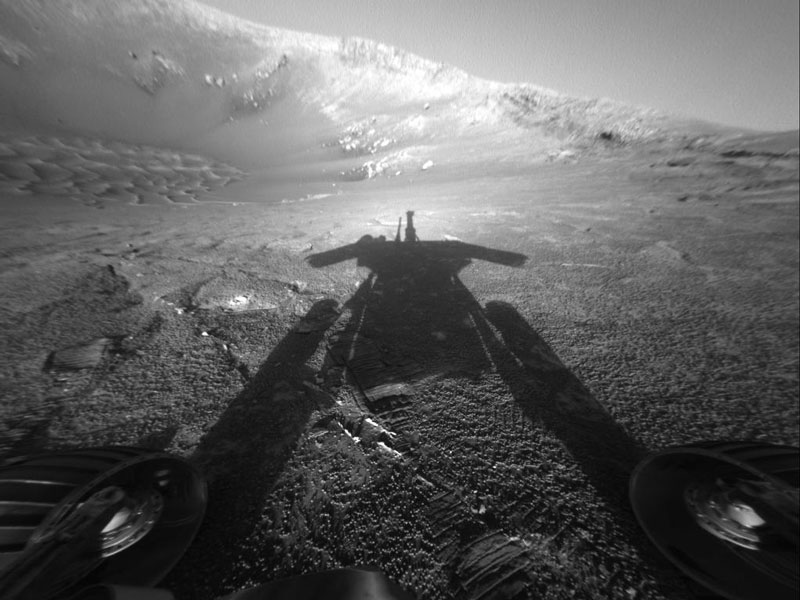
What if you saw your shadow on Mars and it wasn't human? Then you might be the Opportunity rover currently exploring Mars. Opportunity and sister robot Spirit have been probing the red planet since early 2004, finding evidence of ancient water, and sending breathtaking images across the inner Solar System. Pictured above, Opportunity looks opposite the Sun into Endurance Crater and sees its own shadow. Two wheels are visible on the lower left and right, while the floor and walls of the unusual crater are visible in the background. Opportunity and Spirit have now spent over three years exploring the red world, find new clues into the wet ancient past of our Solar System's second most habitable planet.

Friday, February 02, 2007

Flame Nebula


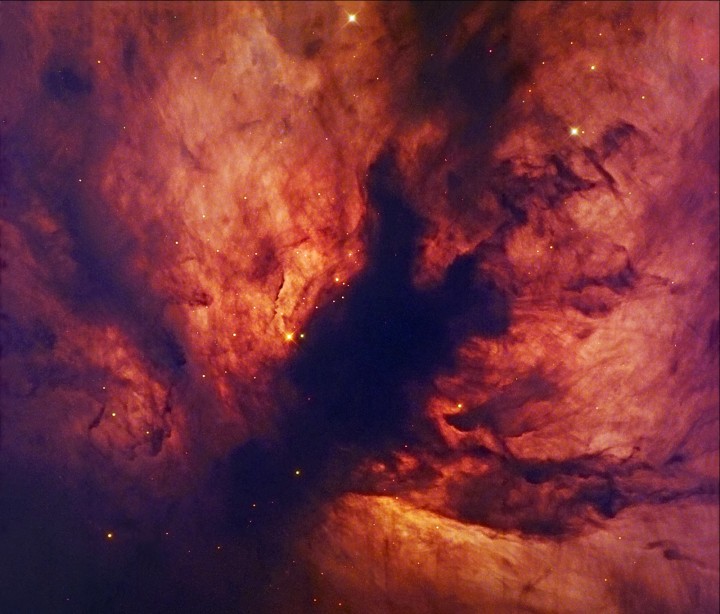
Of course, the Flame Nebula is not on fire. Also known as NGC 2024, the nebula's suggestive reddish color is due to the glow of hydrogen atoms at the edge of the giant Orion molecular cloud complex some 1,500 light-years away. The hydrogen atoms have been ionized, or stripped of their electrons, and glow as the atoms and electrons recombine. But what ionizes the hydrogen atoms? In this close-up view, a dark lane of absorbing interstellar dust stands out in silhouette against the hydrogen glow and actually hides the true source of the Flame Nebula's energy from optical telescopes. Behind the dark lane lies a cluster of hot, young stars, seen at infrared wavelengths through the obscuring dust. A young, massive star in that cluster is the likely source of energetic ultraviolet radiation that ionizes the hydrogen gas in the Flame Nebula.

Friday, January 26, 2007

The Sombrero Galaxy in Infrared


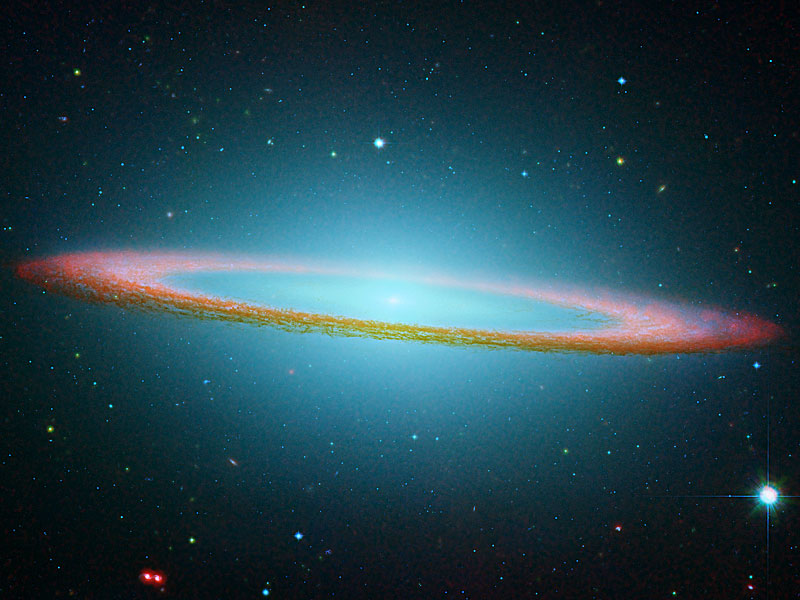
This floating ring is the size of a galaxy. In fact, it is part of the photogenic Sombrero Galaxy, one of the largest galaxies in the nearby Virgo Cluster of Galaxies. The dark band of dust that obscures the mid-section of the Sombrero Galaxy in optical light actually glows brightly in infrared light. The above image shows the infrared glow, recently recorded by the orbiting Spitzer Space Telescope, superposed in false-color on an existing image taken by NASA's Hubble Space Telescope in optical light. The Sombrero Galaxy, also known as M104, spans about 50,000 light years across and lies 28 million light years away. M104 can be seen with a small telescope in the direction of the constellation Virgo.

Thursday, January 25, 2007

Orion's Cradle


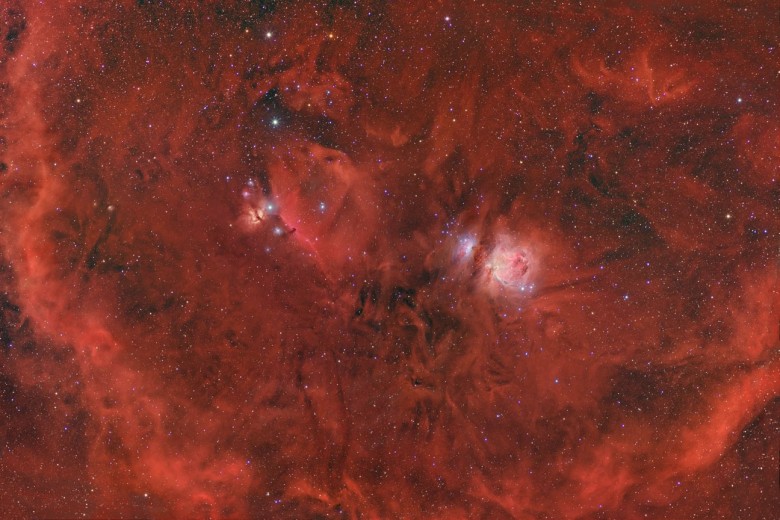
Cradled in glowing hydrogen, stellar nurseries in Orion lie at the edge of a giant molecular cloud some 1,500 light-years away. This breath-taking view spans about 13 degrees across the center of the well-known constellation with the Great Orion Nebula, the closest large star forming region, just right of center. The deep mosaic also includes (left of center), the Horsehead Nebula, the Flame Nebula, and Orion's belt stars. Image data acquired with a hydrogen alpha filter adds other remarkable features to this wide angle cosmic vista -- pervasive tendrils of energized atomic hydrogen gas and portions of the surrounding Barnard's Loop. While the Orion Nebula and belt stars are easy to see with the unaided eye, emission from the extensive interstellar gas is faint and much harder to record, even in telescopic views of the nebula-rich complex.

Monday, January 22, 2007

Saturnian Psychedelia


This psychedelic view of Saturn and its rings is a composite made from images taken with the Cassini spacecraft wide-angle camera using spectral filters sensitive to wavelengths of infrared light centered at 728, 752 and 890 nanometers.

Cassini acquired the view on Dec. 13, 2006 at a distance of approximately 822,000 kilometers (511,000 miles) from Saturn. Image scale is 46 kilometers (28 miles) per pixel.

The Cassini-Huygens mission is a cooperative project of NASA, the European Space Agency and the Italian Space Agency. The Jet Propulsion Laboratory, a division of the California Institute of Technology in Pasadena, manages the mission for NASA's Science Mission Directorate, Washington, D.C. The Cassini orbiter and its two onboard cameras were designed, developed and assembled at JPL. The imaging operations center is based at the Space Science Institute in Boulder, Colo.

For more information about the Cassini-Huygens mission visit http://saturn.jpl.nasa.gov . The Cassini imaging team homepage is at http://ciclops.org .

Credit: NASA/JPL/Space Science Institute

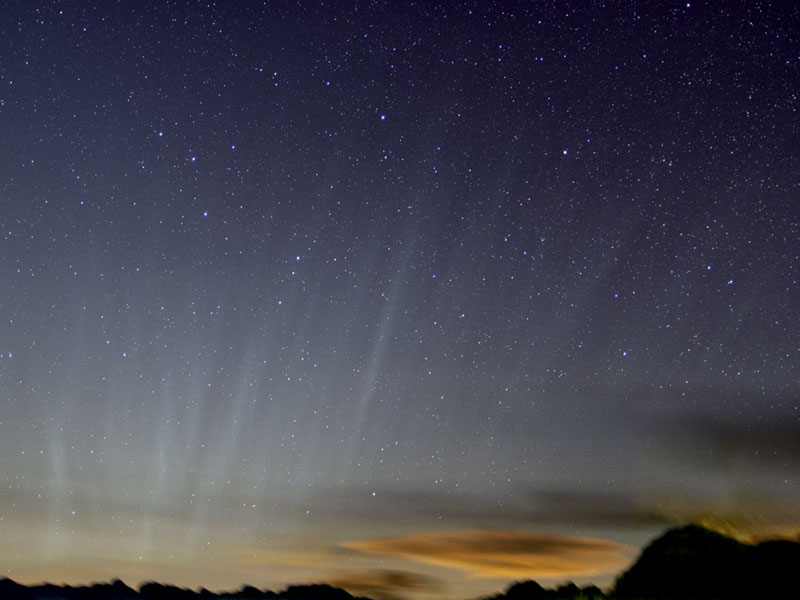
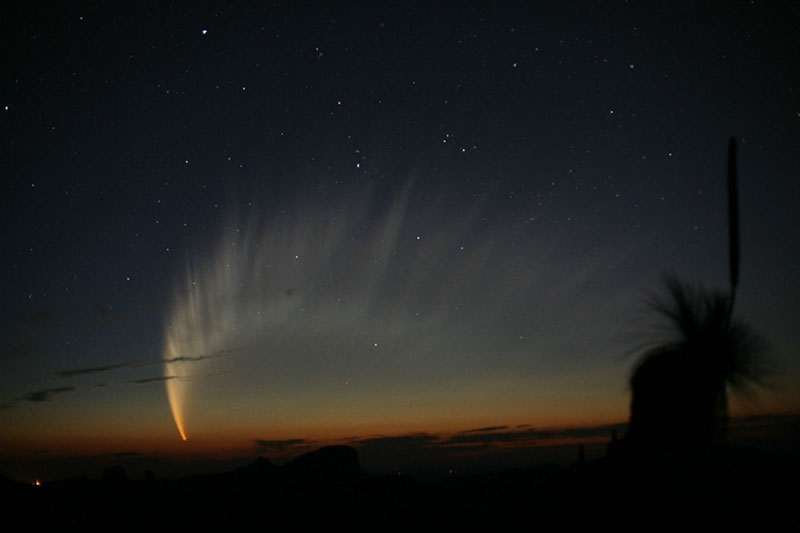
The Magnificent Tail of Comet McNaught


Comet McNaught, the Great Comet of 2007, has grown a long and filamentary tail. The spectacular tail spreads across the sky and is visible to Southern Hemisphere observers just after sunset. The head of the comet remains quite bright and easily visible to even city observers without any optical aide. The amazing tail is visible on long exposures and even to the unaided eye from a dark location. Reports even have the tail visible just above the horizon after sunset for many northern observers as well. Comet McNaught, estimated at magnitude -2 (minus two), was caught by the comet's discoverer in the above image just after sunset last Friday from Siding Spring Observatory in Australia. Comet McNaught, the brightest comet in decades, is now fading as it moves further into southern skies and away from the Sun and Earth.

Saturday, January 20, 2007

Auroras from Space


If Iris, the goddess of the rainbow, had a sister she would be the goddess of Aurora. Glowing green ripples form arcs that constantly transform their shape into new glowing diaphanous forms. There is nothing static about auroras. They are always moving, always changing, and like snowflakes, each display is different from the last. Sometimes, there is a faint touch of red layered above the green. There are bright spots within the arcs that come and go, and transform into upward directed rays topped by feathery red structures. Sometimes there will be six or more rays, sometimes none at all.

source: earthobservatory.nasa.gov

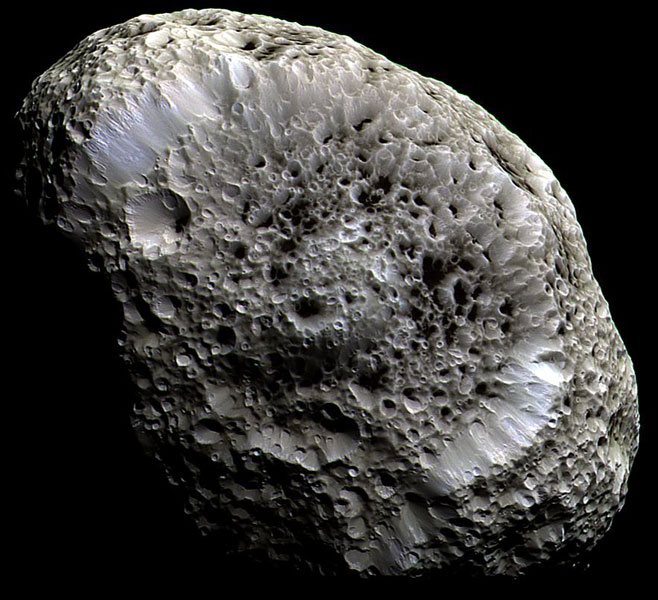
Saturn's Hyperion


What lies at the bottom of Hyperion's strange craters? Nobody knows. To help find out, the robot Cassini spacecraft now orbiting Saturn swooped past the sponge-textured moon again last week and took an image of unprecedented detail. That image, shown above in false color, shows a remarkable world strewn with strange craters and a generally odd surface. The slight differences in color likely show differences in surface composition. At the bottom of most craters lies some type of unknown dark material. Inspection of the image shows bright features indicating that the dark material might be only tens of meters thick in some places. Hyperion is about 250 kilometers across, rotates chaotically, and has a density so low that it might house a vast system of caverns inside.

Friday, January 19, 2007

On Approach: Jupiter and Io

This image was taken on Jan. 8, 2007, with the New Horizons Long Range Reconnaissance Imager (LORRI), while the spacecraft was about 81 million kilometers (about 50 million miles) from Jupiter. Jupiter's volcanic moon Io is to the right; the planet's Great Red Spot is also visible. The image was one of 11 taken during the Jan. 8 approach sequence, which signaled the opening of the New Horizons Jupiter encounter.

Even in these early approach images, Jupiter shows different face than what previous visiting spacecraft - such as Voyager 1, Galileo and Cassini - have seen. Regions around the equator and in the southern tropical latitudes seem remarkably calm, even in the typically turbulent "wake" behind the Great Red Spot.

The New Horizons science team will scrutinize these major meteorological features - including the unexpectedly calm regions - to understand the diverse variety of dynamical processes on the solar system's largest planet. These include the newly formed Little Red Spot, the Great Red Spot and a variety of zonal features.

Credit: NASA/Johns Hopkins University Applied Physics Laboratory/Southwest Research Institute.

Monday, January 15, 2007

Comet McNaught via SOHO Satellite

This is an animation of the most recent images from the SOHO spacecraft's LASCO C3 camera.

Expect it to load slowly

Comet C/2006 P1 (McNaught) will be visible from Friday, Jan. 12 to Monday, Jan. 15. The first SOHO images of the comet can be seen in our Comet McNaught Viewer's Guide.

This real-time movie, which shows the most recent 48 hours of solar activity, is updated every hour if satellite communications permit. The image is generated by the Solar and Heliospheric Observatory (SOHO) spacecraft.

Other animation sizes and formats are avaible at the SOHO site.

Instruments on SOHO makes images like this one by blocking the light coming directly from the Sun with an occulter disk, creating an artificial eclipse within the instrument itself. The lack of detail (notice that the tail is all white) occurs because the comet is so bright it saturates the image detector. The small moving dot is Mercury.

SOHO is a project of international cooperation between ESA and NASA.

More SPACE.com Cams

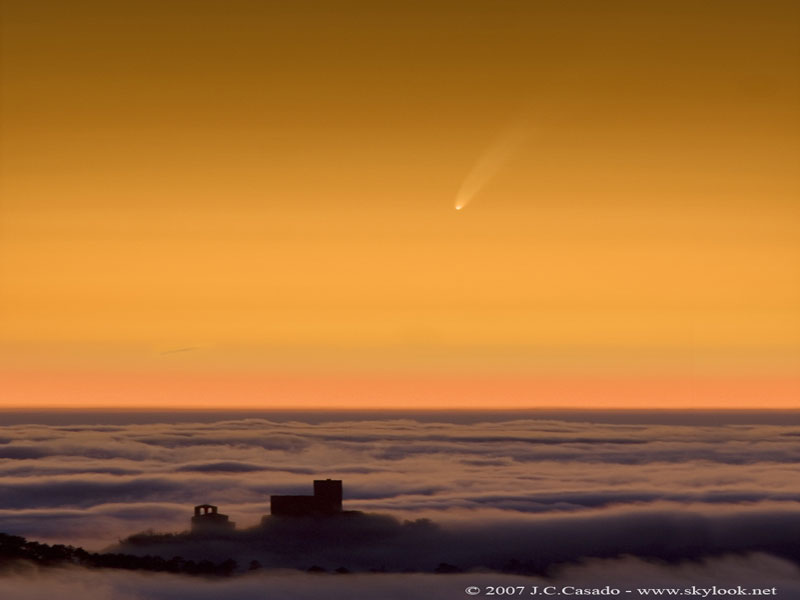
Comet McNaught Over Catalonia, Spain


This past weekend Comet McNaught peaked at a brightness that surpassed even Venus. Fascinated sky enthusiasts in the Earth's northern hemisphere were treated to an instantly visible comet head and a faint elongated tail near sunrise and sunset. Recent brightness estimates had Comet McNaught brighter than magnitude -5 (minus five) over this past weekend, making it the brightest comet since Comet Ikeya-Seki in 1965, which was recorded at -7 (minus seven). The Great Comet of 2007 reached its brightest as it rounded the Sun well inside the orbit of Mercury. Over the next week Comet McNaught will begin to fade as it moves south and away from the Sun. The unexpectedly bright comet should remain visible to observers in the southern hemisphere with unaided eyes for the rest of January. The above image, vertically compressed, was taken at sunset last Friday from mountains above Catalonia, Spain.

Friday, January 12, 2007

Pillars of Creation


This majestic view, taken by NASA's Spitzer Space Telescope, tells an untold story of life and death in the Eagle Nebula, an industrious star-making factory located 7,000 light-years away in the Serpens Sonstellation. The image shows the region's entire network of turbulent clouds and newborn stars in infrared light.

The color green denotes cooler towers and fields of dust, including the three famous space pillars, dubbed the "Pillars of Creation," which were photographed by NASA's Hubble Space Telescope in 1995 (right of center; see http://www.nasa.gov/mission_pages/spitzer/multimedia/ssc2007-01b.html for exact location).

But it is the color red that speaks of the drama taking place in this region. Red represents hotter dust thought to have been warmed by the explosion of a massive star about 8,000 to 9,000 years ago. Since light from the Eagle Nebula takes 7,000 years to reach us, this supernova explosion would have appeared as an oddly bright star in our skies about 1,000 to 2,000 years ago.

According to astronomers' estimations, the explosion's blast wave would have spread outward and toppled the three pillars about 6,000 years ago (which means we wouldn't witness the destruction for another 1,000 years or so). The blast wave would have crumbled the mighty towers, exposing newborn stars that were buried inside, and triggering the birth of new ones.

source: nasa.gov

Thursday, January 11, 2007

NASA Finally Goes Metric

"Space.com is reporting that NASA has decided to use the metric system for its new lunar missions. NASA hopes that metrication will allow easier international participation and safer missions. The loss of the Mars Climate Orbiter was blamed on an error converting between English units and metric units. 'When we made the announcement at the meeting, the reps for the other space agencies all gave a little cheer,' said a NASA official."

source: space.com

Sunday, January 07, 2007

Dazzling Dunes

Endurance Crater
As NASA's Mars Exploration Rover Opportunity creeps farther into "Endurance Crater," the dune field on the crater floor appears even more dramatic. This false-color image taken by the rover's panoramic camera shows that the dune crests have accumulated more dust than the flanks of the dunes and the flat surfaces between them. Also evident is a "blue" tint on the flat surfaces as compared to the dune flanks. This results from the presence of the hematite-containing spherules, or "blueberries", that accumulate on the flat surfaces.

Sinuous tendrils of sand less than 1 meter (3.3 feet) high extend from the main dune field toward the rover. Scientists hope to send the rover down to one of these tendrils in an effort to learn more about the characteristics of the dunes. Dunes are a common feature across the surface of Mars, and knowledge gleaned from investigating the Endurance dunes may apply to similar dunes elsewhere.

Before the rover heads down to the dunes, rover drivers must first establish whether the slippery slope that leads to them is firm enough to ensure a successful drive back out of the crater. Otherwise, such hazards might make the dune field a true sand trap.

source: nasa.gov

Hubble maps cosmic web of 'clumpy' dark matter in 3-D

SEATTLE - An international team of astronomers using NASA's Hubble Space Telescope has created the first three-dimensional map of the large-scale distribution of dark matter in the universe.


Dark matter is an invisible form of matter whose total mass in the universe is more than five times that of "normal" matter (i.e., atoms). The nature of dark matter is still unknown. Its presence in the universe is inferred from its current influence within galaxies and clusters of galaxies, and the gravitational effect it has had on the evolution of structure in the universe. The first direct detection of dark matter was made this past year through observations of the Bullet Cluster of galaxies.

This new map provides the best evidence to date that normal matter, largely in the form of galaxies, accumulates along the densest concentrations of dark matter. The map reveals a loose network of filaments that grew over time and intersect in massive structures at the locations of clusters of galaxies.

The map stretches halfway back to the beginning of the universe and shows how dark matter has grown increasingly "clumpy" as it collapses under gravity.

The dark matter map was constructed by measuring the shapes of half a million faraway galaxies. To reach Hubble, the light of the galaxies traveled through intervening dark matter. The dark matter deflected the light slightly as it traveled through space. Researchers used the observed, subtle distortion of the galaxies' shapes to reconstruct the distribution of intervening mass along Hubble's line of sight, a method called "weak gravitational lensing."

For astronomers, the challenge of mapping dark matter in the universe has been similar to mapping a city from nighttime aerial snapshots showing only streetlights. Dark matter is invisible, so only the luminous galaxies can be seen directly. These new map images are equivalent to seeing a city, its suburbs and country roads in daylight for the first time. Major arteries and intersections become evident, and a variety of neighborhoods are visible.


Mapping dark matter's distribution in space and time is fundamental to understanding how galaxies grew and clustered over billions of years. Tracing the growth of clustering in dark matter may eventually also shed light on dark energy, a repulsive form of gravity that would have influenced how dark matter clumps.

The research results appeared online today in the journal Nature and were presented at the 209th meeting of the American Astronomical Society in Seattle, Wash., by Richard Massey and Nick Scoville. Both researchers are from the California Institute of Technology, Pasadena, Calif.

"It's reassuring how well our map confirms the standard theories for structure formation," said Massey. He calls dark matter the "scaffolding" inside of which stars and galaxies have been assembled over billions of years.

Researchers created the map using the Hubble's largest survey to date of the universe, the Cosmic Evolution Survey, otherwise known as COSMOS. The survey covers an area of sky nine times the area of the Earth's moon. This allows for the large-scale filamentary structure of dark matter to be evident. To add 3-D distance information, the Hubble observations were combined with multicolor data from powerful ground-based telescopes, Europe's Very Large Telescope in Chile, Japan's Subaru telescope in Hawaii, the U.S.'s Very Large Array radio telescope, New Mexico, as well as the European Space Agency's orbiting XMM-Newton X-ray telescope.

The Hubble Space Telescope is a project of international cooperation between NASA and the European Space Agency. The Space Telescope Science Institute, Baltimore, conducts Hubble science operations. The Institute is operated for NASA by the Association of Universities for Research in Astronomy, Inc., Washington.

source: spaceflightnow.com

Pluto's revenge: 'Word of the Year' award


(CNN) -- Pluto may no longer be a planet, but it has a new claim to fame: "Plutoed" has been chosen 2006 Word of the Year by the American Dialect Society.

The society defined "to pluto" as "to demote or devalue someone or something, as happened to the former planet Pluto when the General Assembly of the International Astronomical Union decided Pluto no longer met its definition of a planet."

The former planet had some tough competition in the voting, which took place Friday at the ADS' annual meeting, held in Anaheim, California.

"Plutoed" won in a runoff against "climate canary," defined as "an organism or species whose poor health or declining numbers hint at a larger environmental catastrophe on the horizon."

The runner-up was "macaca" or "macaca moment," defined as "treating an American citizen as an alien" -- a reference to a campaign remark by former Virginia Sen. George Allen that some say marked the beginning of the end for his re-election hopes.

Also in the running for Word of the Year were YouTube; surge (referring to a large, but brief, increase in troop strength); and flog ("a fake blog created by a corporation to promote a product or a television show").

Like any good awards show, the ADS meeting had multiple categories.

In the "Most Unnecessary" category, "SuriKat" (the supposed nickname of the baby girl of Tom Cruise and Katie Holmes) beat out "the decider," President Bush's description in April of his position in relation to whether Donald Rumsfeld kept his job as secretary of defense.

The "Most Outrageous" award went to "Cambodian accessory," defined as "Angelina Jolie's adopted child who is Cambodian."

In the "Most Euphemistic" category, the winner was "waterboarding," defined as "an interrogation technique in which the subject is immobilized and doused with water to simulate drowning."

The ADS has been choosing Words of the Year since 1990. The Word of the Year for 2005 was "truthiness," invented by Comedy Central's "The Colbert Report," and defined by the ADS as "what one wishes to be the truth regardless of the facts." (Read the full list of winners for 2006 and past yearsexternal link)

Winning words or phrases don't have to be brand new; what's important is that they gained new prominence in the past year.

The society is dedicated to the study of the English language in North America, and includes academics, writers, and others.

source: cnn.com

Google joins LSST project

NEW YORK: Google has become part of a group of universities, national laboratories and private foundations, which is building the Large Synoptic Survey Telescope to probe into the mysteries of the universe.

The telescope, to become operational in 2013, has a three billion pixel digital camera, which is capable of surveying the whole of visible sky in multiple colors every week. It is particularly scheduled to look into the mysteries of dark matter and dark energy and will provide a colorful glimpse on celestial objects that change or move rapidly like the exploding supernovae, near-earth asteroids and the Kuiper Belt objects.

The decade-long survey is expected to generate more than 30,000 gigabytes of image data every night and Google's participation in the project is to ensure that this massive data is properly and organized and preserved for proper and easy use.

Donald Sweeney, project manager for the Large Synoptic Survey Telescope said Google will help organize "the seemingly overwhelming volumes of collected data" into a database, which will make discoveries available in real time for scientists and non-scientists alike.

William Coughran, Google's vice president of engineering said the company's mission is to take the world's information and make it universally accessible and useful. He said the data from the project will be an important part of the world's information, and by being involved in the project Google hopes to make it easier for that data to become accessible and useful.

full story: earthtimes.org